
Imagine you are chatting with a friend and suddenly come across a word, abbreviation, or phrase you have never seen before.
Your friend writes, “I’ll be there in 10, BTW.”
You understand the sentence, but then you wonder: What does BTW mean? Is it slang? Is there another meaning in text?
This happens all the time in online conversations. People use short words, abbreviations, emojis, and internet slang to communicate faster. Because texting is different from speaking face-to-face, a simple word can sometimes have a completely different feeling depending on the context.
That is why people often search for the meaning in text when they see an unfamiliar term in a message, WhatsApp chat, Snapchat conversation, Instagram comment, TikTok post, or Discord discussion.
In this guide, we will explain what meaning in text refers to, how context changes meaning, how slang works, and how you can understand unfamiliar words without getting confused.
Quick Answer:
Meaning in text refers to the definition or intended message of a word, phrase, abbreviation, emoji, or slang term when it is used in a text conversation.
The same word can sometimes have different meanings depending on who sent it, the platform, and the situation.
- It helps explain unfamiliar texting slang.
- It can reveal the emotional tone of a message.
- It is useful for understanding abbreviations and acronyms.
- Context is important when finding a slang meaning in text.
- A word may have a normal dictionary meaning and a different online meaning.
- The sender’s relationship with you can also affect its meaning.
For example, “LOL” usually means “laughing out loud,” but someone may also use it simply to make a message feel lighter or less serious.
What Does Meaning in Text Mean?
The phrase meaning in text simply refers to understanding what a particular word, phrase, abbreviation, emoji, or sentence means when someone uses it in a written conversation.
Texting has created its own style of communication. People often shorten words because typing a long sentence can take more time.
For example:
“What are you doing?” may become “wyd?”
“I don’t know” may become “idk.”
“Be right back” may become “brb.”
The basic idea is simple: people want to communicate quickly while still getting their message across.
However, the meaning is not always obvious. Some abbreviations can have several interpretations. A person may also use the same expression differently with friends, family, coworkers, or someone they like.
For example:
Person A: “You coming tonight?”
Person B: “Bet.”
Here, “bet” does not literally mean a wager. In modern texting slang, it can mean “okay,” “sure,” or “deal.”
That is why understanding the meaning in text requires more than simply looking at a dictionary definition.
Mini Example 1
Message: “IDK what happened.”
Meaning: “I don’t know what happened.”
Mini Example 2
Message: “HMU later.”
Meaning: “Hit me up later.”
Mini Example 3
Message: “FR, that was crazy.”
Meaning: “For real, that was crazy.”
These examples show why online language can feel confusing at first. Once you understand common slang, however, reading texts becomes much easier.
Where Is Meaning in Text Commonly Used?
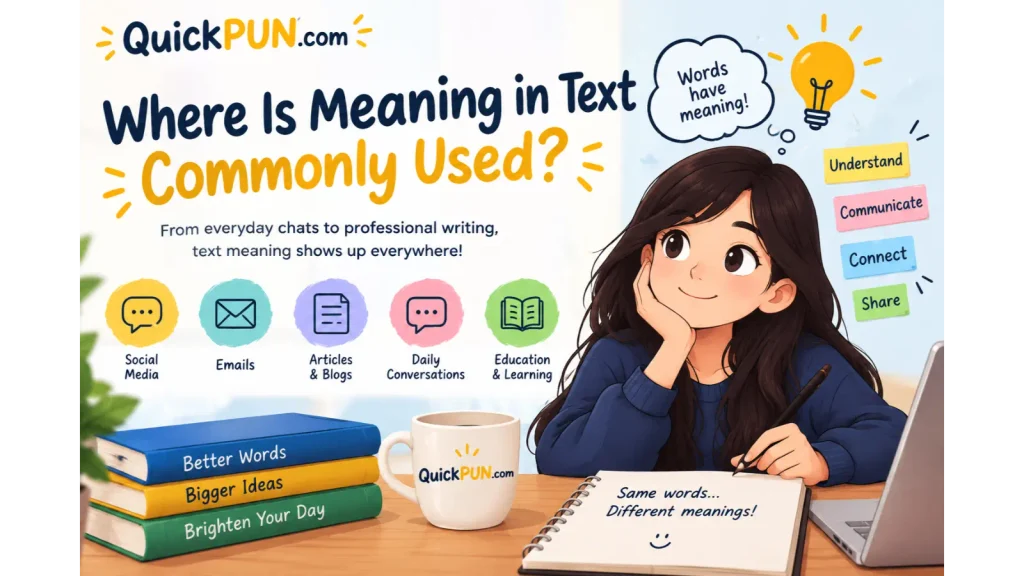
The idea of finding a meaning in text is especially common across social media and messaging platforms. Each platform has its own communication style, but many slang terms are used across several apps.
Text Messages
Traditional SMS conversations often contain abbreviations because people want to type quickly.
Common examples include:
- LOL
- OMG
- IDK
- BTW
- FYI
- TTYL
- BRB
- GTG
These expressions make casual conversations shorter and easier.
WhatsApp is widely used for personal conversations, group chats, family messages, and work communication.
You may see phrases such as:
“wyd?”
“hmu”
“ttyl”
“ngl”
“ikr”
The meaning usually depends on the conversation around the abbreviation.
Snapchat
Snapchat has a strong connection with casual slang and short-form communication.
Users often use abbreviations because messages are designed to be quick and informal.
For example:
“wyd rn?”
can mean:
“What are you doing right now?”
Instagram users frequently use slang in comments, direct messages, captions, and replies.
A person might comment:
“FR 😂”
Here, “FR” usually means “for real.”
The emoji can also strengthen the emotional meaning.
TikTok
TikTok has helped spread many slang terms and internet expressions.
Words that become popular in videos can quickly appear in comments and private messages. This means the slang meaning in text can change as online culture evolves.
Gaming and Discord
Gaming communities use abbreviations heavily because players often need to communicate quickly.
Examples include:
- GG — Good game
- AFK — Away from keyboard
- BRB — Be right back
- GLHF — Good luck, have fun
- OP — Overpowered or original poster, depending on context
In gaming, context is especially important because the same abbreviation can have different meanings.
Tone and Meaning Explained
Finding the correct meaning in text is not only about knowing what the letters stand for. You should also understand the tone.
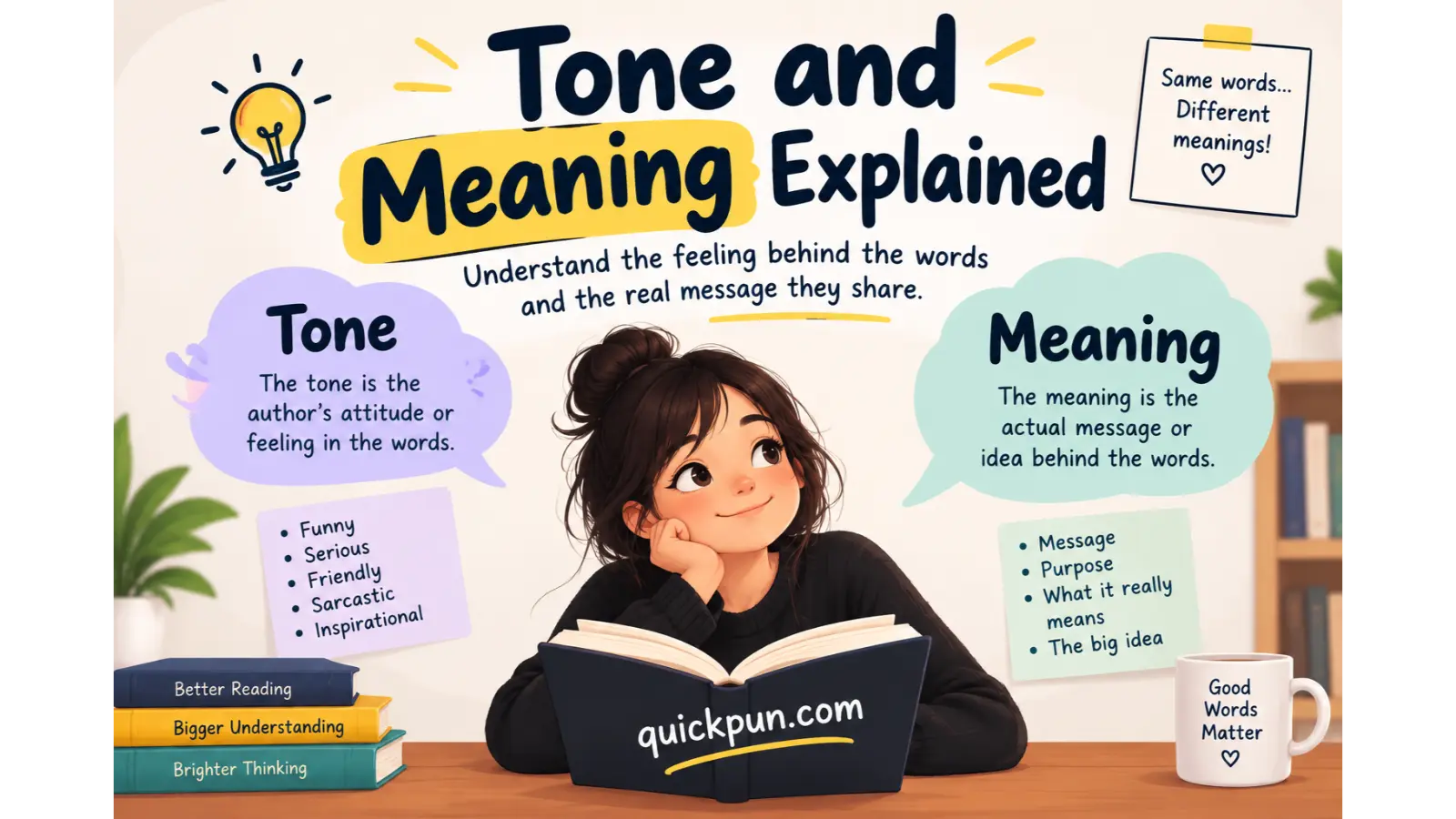
The same abbreviation can sound friendly in one conversation and cold in another.
Friendly Tone
A friendly message usually feels warm, relaxed, and natural.
For example:
“LOL 😂 you actually did that?”
The “LOL” and laughing emoji make the message playful.
Another example:
“TYSM! ❤️”
This sounds warm and appreciative.
Neutral Tone
Some expressions are simply practical.
For example:
“FYI, the meeting starts at 3.”
Here, “FYI” means “for your information.” There is no strong emotional message behind it.
Rude or Cold Tone
Sometimes a short response can feel cold even if the words themselves are not offensive.
For example:
“K.”
The person may simply mean “okay,” but depending on the relationship, it can sound annoyed or dismissive.
Similarly:
“Fine.”
could mean genuine agreement, frustration, or passive-aggressive acceptance.
This is why punctuation, timing, emojis, and previous messages can matter when understanding a meaning in chat.
Examples of Meaning in Text in Conversation
Here are several realistic examples showing how context affects texting language.
Example 1: “LOL”
Alex: “I just walked into the wrong classroom.”
Sam: “LOL 😂”
Here, “LOL” shows amusement.
Example 2: “IDK”
Mia: “Are you coming tomorrow?”
Jake: “IDK yet.”
Here, “IDK” means “I don’t know.”
Example 3: “BTW”
Sarah: “BTW, don’t forget your charger.”
“BTW” means “by the way.”
It introduces an additional piece of information.
Example 4: “FR”
Tom: “That movie was amazing.”
Ryan: “FR! I loved it.”
“FR” means “for real” and shows agreement.
Example 5: “HMU”
Liam: “HMU when you’re free.”
“HMU” means “hit me up.”
The speaker is asking the other person to contact them.
Example 6: “NGL”
Emma: “NGL, I was nervous before the test.”
“NGL” means “not gonna lie.”
It introduces an honest or personal statement.
Example 7: “WYD”
Noah: “WYD?”
Olivia: “Just watching a movie.”
“WYD” means “what are you doing?”
These examples demonstrate an important point: the abbreviation alone does not always tell the entire story. The surrounding conversation gives you the real meaning.
Meaning in Text From a Girl
When people search for meaning in text from a girl, they are often trying to understand the emotional intention behind her message.
However, there is no universal rule that every girl uses slang in the same way. A person’s personality, age, friendship, and texting habits matter much more than gender.
For example, if a girl sends:
“LOL 😂”
she may simply find something funny.
If she sends:
“wyd?”
she may be casually asking what you are doing.
If she says:
“aww tysm ❤️”
the message may feel warm and appreciative.
But you should not assume that a particular abbreviation automatically means romantic interest.
For example, “ILY” can mean “I love you,” but the meaning can depend on whether the conversation is between romantic partners, close friends, or family members.
The best way to understand a message is to look at the whole conversation, not one word.
Meaning in Text From a Guy
The same principle applies when someone searches for meaning in text from a guy.
Guys may use short forms, gaming slang, memes, emojis, and abbreviations to communicate quickly.
For example:
“Bet”
may mean:
- Okay
- Sure
- Deal
- Sounds good
A message like:
“Nah fr”
can mean:
“No, seriously” or “I genuinely agree.”
A short message does not necessarily mean the person is uninterested. Some people naturally text in short sentences.
Instead of judging the message by length alone, consider the person’s normal texting style and the conversation’s context.
Is Meaning in Text Ever Rude or Offensive?
Yes, some expressions can sound rude depending on how they are used.
A slang term may not be offensive by itself, but the tone can change its effect.
Dry
A very short response may feel dry.
“k”
“ok”
“sure”
These can be completely normal, but they may also feel uninterested depending on the situation.
Passive-Aggressive
Sometimes a person intentionally uses a short or overly simple response to show irritation.
For example:
“Fine.”
or
“Whatever.”
The literal meaning is simple, but the emotional message may be stronger.
Polite
Some abbreviations can still be polite when used appropriately.
For example:
“TY!”
means “thank you.”
“NP”
usually means “no problem.”
“FYI”
can be neutral and useful in work-related messages.
The key is to consider the relationship and situation before deciding whether something is rude.
When to Use and When NOT to Use Meaning in Text Slang
| When to Use ✅ | When NOT to Use ❌ |
|---|---|
| Casual conversations with friends | Formal business emails |
| Social media comments | Important professional documents |
| Group chats | Job applications |
| Gaming conversations | Academic assignments |
| Casual WhatsApp messages | Serious complaints |
| Conversations with people who understand slang | When the recipient may misunderstand it |
Slang is most useful when both people understand the style of communication.
For example, saying “LOL” to your close friend is perfectly normal.
But writing “LOL” in a formal application to a company would usually be inappropriate.
Knowing the audience is one of the most important parts of effective communication.
Meaning in Chat vs Social Media
The meaning in chat can sometimes be different from the meaning of the same expression on social media.
In private chats, people usually have more personal context.
For example:
“You’re crazy 😂”
between close friends may be a playful compliment.
On a public post, however, the same phrase could be interpreted differently.
Social media also creates trends. A slang word can become popular because of TikTok videos, memes, influencers, or online communities.
A term may start with one meaning and later develop another.
This is why searching for the exact meaning in text can be useful when you encounter unfamiliar internet slang.
Context should always be your first clue.
Similar Slang Words or Alternatives
There are many common texting expressions that can replace longer phrases.
| Word or Slang | Meaning | Usage |
|---|---|---|
| LOL | Laughing out loud | Showing amusement |
| IDK | I don’t know | Expressing uncertainty |
| BTW | By the way | Adding information |
| FYI | For your information | Sharing information |
| BRB | Be right back | Temporarily leaving |
| GTG | Got to go | Ending a conversation |
| TTYL | Talk to you later | Ending a chat |
| HMU | Hit me up | Asking someone to contact you |
| NGL | Not gonna lie | Introducing honesty |
| TBH | To be honest | Giving an honest opinion |
| FR | For real | Showing agreement or seriousness |
| IMO | In my opinion | Sharing an opinion |
| WYA | Where you at? | Asking someone’s location |
| WYD | What are you doing? | Asking about activity |
| DW | Don’t worry | Reassuring someone |
These abbreviations are common examples of how online communication has become shorter and faster.
Other Meanings of Meaning in Text
The phrase “meaning in text” itself does not normally refer to one specific slang abbreviation.
Instead, it is a general search phrase people use when they want to understand something written in a message.
For example, someone might search:
“FR meaning in text”
or
“WYF meaning in text”
or
“HM meaning in text.”
In each case, the phrase “meaning in text” tells us that the person wants the definition of that particular expression as it is used in texting.
The word “meaning” can also refer to the intended idea behind a complete sentence.
For example:
“I guess that’s fine.”
The dictionary meaning is easy to understand, but the emotional meaning could vary.
It could show:
- Acceptance
- Disappointment
- Anger
- Uncertainty
- Indifference
This is why language has both literal meaning and contextual meaning.
Why Do People Use Meaning in Text Slang?
People use slang and abbreviations for several simple reasons.
Fast Typing
Texting is designed to be quick.
Typing:
“What are you doing?”
takes longer than:
“WYD?”
For casual conversations, saving a few seconds can be useful.
Internet Culture
Online communities develop their own vocabulary.
New slang can spread through:
- TikTok
- YouTube
- Discord
- Gaming communities
- Memes
Once enough people start using a term, it can become part of everyday online communication.
Convenience
Short expressions make conversations easier.
Instead of writing:
“Not gonna lie, I completely agree with you.”
someone may write:
“NGL, FR.”
The message becomes much shorter while remaining understandable to people familiar with the slang.
Personal Style
Some people simply enjoy texting with slang.
They may use abbreviations because they make messages feel casual, funny, or more natural.
Others prefer complete sentences.
Neither style is necessarily better. It depends on the person and situation.
How to Understand an Unknown Texting Term
If you receive a message containing an unfamiliar abbreviation, don’t immediately assume the worst.
Try these steps.
Look at the Full Sentence
The surrounding words often provide clues.
For example:
“I can’t come, GTG.”
The context suggests that GTG is related to leaving.
Consider the Platform
Gaming slang may be different from Instagram slang.
A Discord conversation can contain terms that are uncommon in regular texting.
Check the Relationship
A close friend may use slang casually, while a coworker may use the same abbreviation in a more practical way.
Look at Emojis
Emojis can change the feeling of a message.
Compare:
“Okay.”
with:
“Okay 😂”
The words are identical, but the emotional tone can be different.
Ask if Necessary
If you genuinely do not understand something, simply ask:
“What does that mean?”
There is nothing wrong with asking. Slang changes constantly, so nobody knows every internet expression.
Why Context Matters So Much
Context is one of the biggest factors in understanding a slang meaning in text.
Consider the word:
“Sure.”
It can mean:
“Yes, definitely.”
But it can also sound like:
“I guess.”
The difference comes from the situation and the person’s tone.
Similarly, “LOL” can mean genuine laughter, mild amusement, or simply a way to make a message less serious.
This is why you should avoid making a major conclusion from one abbreviation.
Look at:
- The complete message
- Previous messages
- Punctuation
- Emojis
- The person’s usual style
- Your relationship with them
- The situation
Together, these clues provide a much better understanding.
Common Mistakes When Understanding Text Slang
One common mistake is assuming that every abbreviation has only one meaning.
That is not true.
Another mistake is taking slang literally.
For example, when someone says:
“I’m dead 😂”
they usually do not mean they have literally died. In internet slang, the expression can mean that something is extremely funny.
People also sometimes assume that short replies are automatically rude.
A person may simply be busy or naturally prefer short messages.
Finally, avoid assuming romantic meaning without evidence. A friendly abbreviation, emoji, or compliment does not automatically mean someone has romantic feelings.
FAQs:
What does meaning in text mean?
Meaning in text refers to the definition or intended message of a word, phrase, abbreviation, emoji, or slang expression used in a written conversation.
Why do people search for meaning in text?
People search for it when they see an unfamiliar abbreviation, slang word, phrase, or emoji and want to understand what the sender intended.
Can one text abbreviation have multiple meanings?
Yes. Some abbreviations can have different meanings depending on the platform, community, sentence, or context.
Does texting slang always mean the same thing?
No. Texting slang can change over time, and different groups may use the same expression differently.
How can I understand the meaning of a slang word?
Look at the complete sentence, surrounding conversation, platform, relationship, emojis, and overall tone. If you are still unsure, ask the sender.
Is texting slang appropriate everywhere?
No. Slang is usually best for casual conversations. Formal emails, school assignments, professional documents, and business communication generally require clearer and more formal language.
Final Thoughts:
Understanding the meaning in text is really about understanding how people communicate online.
Texting has created a fast and creative language filled with abbreviations, slang, emojis, and short expressions. A simple combination of letters can sometimes communicate an entire sentence.
The most important thing to remember is that context matters. Don’t judge a message based on one word alone. Look at the conversation, the relationship, the platform, and the tone.
Once you become familiar with common texting slang, those confusing messages will start making much more sense. 💬😊
Whether you are trying to understand a message from a friend, a Snapchat reply, an Instagram comment, or a Discord conversation, knowing the meaning in text can help you communicate with confidence and avoid unnecessary misunderstandings.

Peter Hemsworth is the mind behind QuickPun.com, where everyday words, slang, and internet expressions reveal their hidden stories. With a passion for uncovering what people really mean, he turns simple terms into fascinating reads that keep curious minds coming back for more. Dive in—you might discover there’s far more behind a word than you ever imagined.