
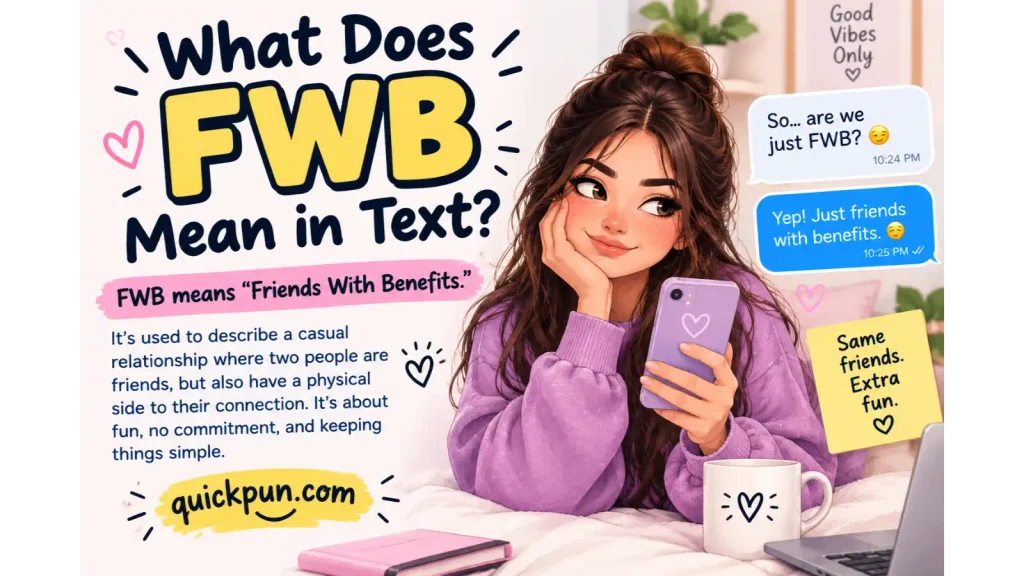
Imagine getting a message from someone you know that says, “Would you be okay with being FWB?” You might read it twice and wonder, “What exactly does FWB mean?” If you have seen this abbreviation in a text, Snapchat message, Instagram DM, or dating conversation, you are definitely not alone.
Texting has created hundreds of short forms that make conversations faster. Some are easy to understand, such as “LOL” or “BRB,” while others can be confusing because their meaning depends heavily on the situation.
FWB is one of those terms.
In texting and online conversations, FWB usually means “friends with benefits.” It generally describes two people who are friends or friendly with each other but have an agreed intimate relationship without considering themselves a traditional romantic couple.
However, the exact meaning can change depending on the people involved. Sometimes someone may use FWB casually, while another person may use it to describe a clear relationship arrangement.
Understanding the FWB meaning in text can help you avoid confusion, especially when the abbreviation appears in a personal message. The tone, relationship between the people, and surrounding words all matter.
Let’s break down the FWB slang meaning, where it is commonly used, what it can mean from a girl or guy, and how to respond when someone sends it to you.
Quick Answer: What Does FWB Mean in Text?
FWB means “friends with benefits” in text messages. It usually refers to two people who maintain a friendship while also having an intimate relationship without calling themselves a traditional romantic couple.
People commonly use FWB when talking about:
- Casual relationships
- Dating situations
- Modern relationship arrangements
- Friendships involving intimacy
- Dating apps and social media conversations
- Personal or private conversations
For example:
Person A: “Are you looking for something serious?”
Person B: “Not really. Maybe FWB.”
Here, the person is saying that they may be interested in a friends-with-benefits arrangement rather than a serious romantic relationship.
Because FWB involves personal boundaries, its meaning should not automatically be assumed beyond the basic abbreviation. Different people may have different expectations.
What Does FWB Mean in Text?
The most common FWB meaning in text is “friends with benefits.”
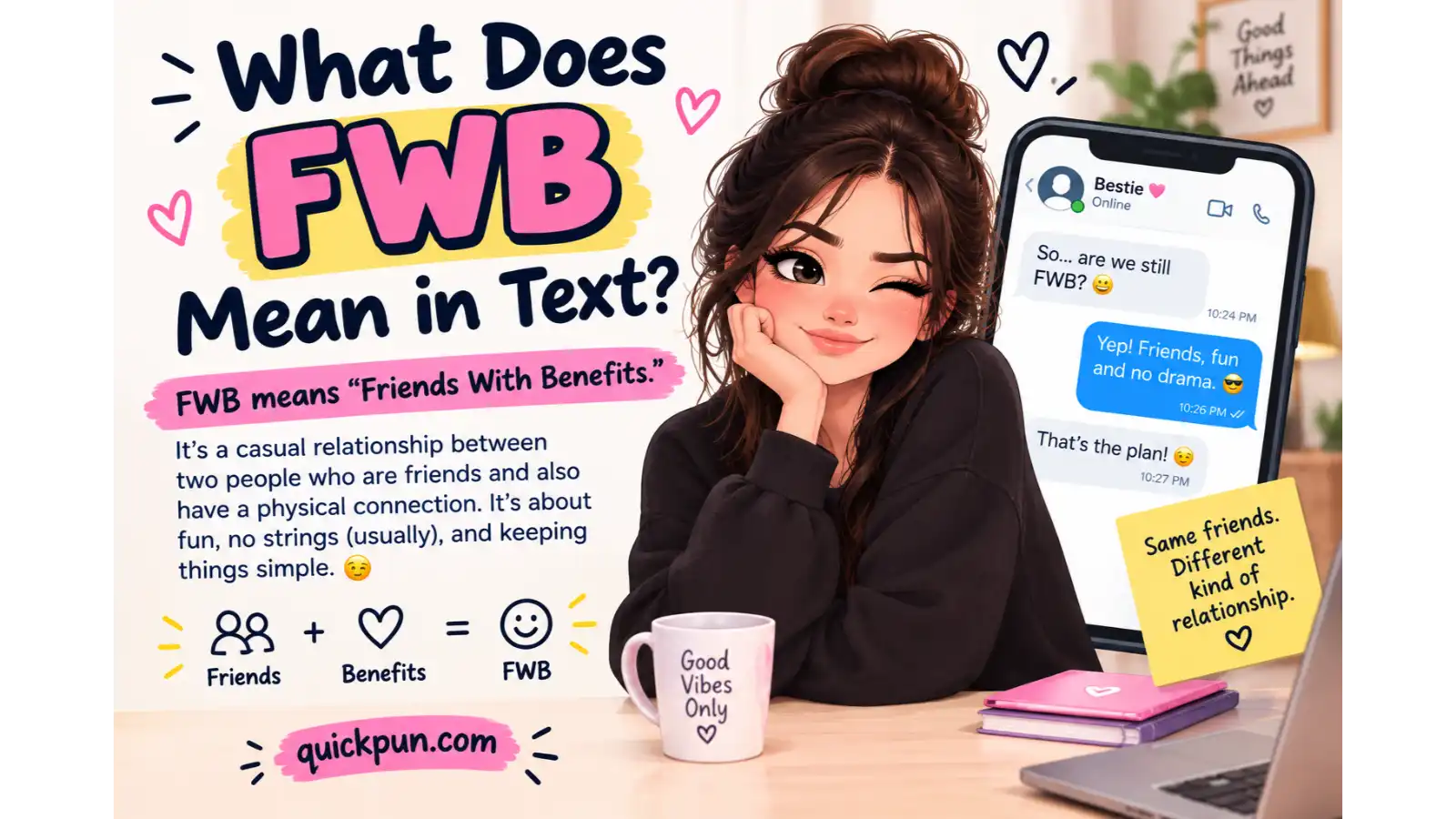
In simple words, it describes a situation where two people are friends or have a friendly connection while also sharing an intimate relationship. Usually, they do not consider themselves a committed romantic couple.
The word “friends” refers to the existing social connection, while “benefits” refers to intimacy that goes beyond an ordinary friendship.
For example:
Example 1:
“Jake and Mia aren’t dating. They’re FWB.”
This means Jake and Mia have a friendship that includes an intimate side, but they are not officially a romantic couple.
Example 2:
“She said she only wants FWB.”
This suggests that she prefers a casual arrangement rather than a serious relationship.
Example 3:
“Are you looking for FWB or something serious?”
The person is asking whether you want a casual arrangement or a committed relationship.
It is important to remember that FWB is not exactly the same as dating. Dating may involve romantic interest, emotional commitment, or the possibility of building a relationship. FWB generally suggests fewer romantic expectations, although real-life situations can vary.
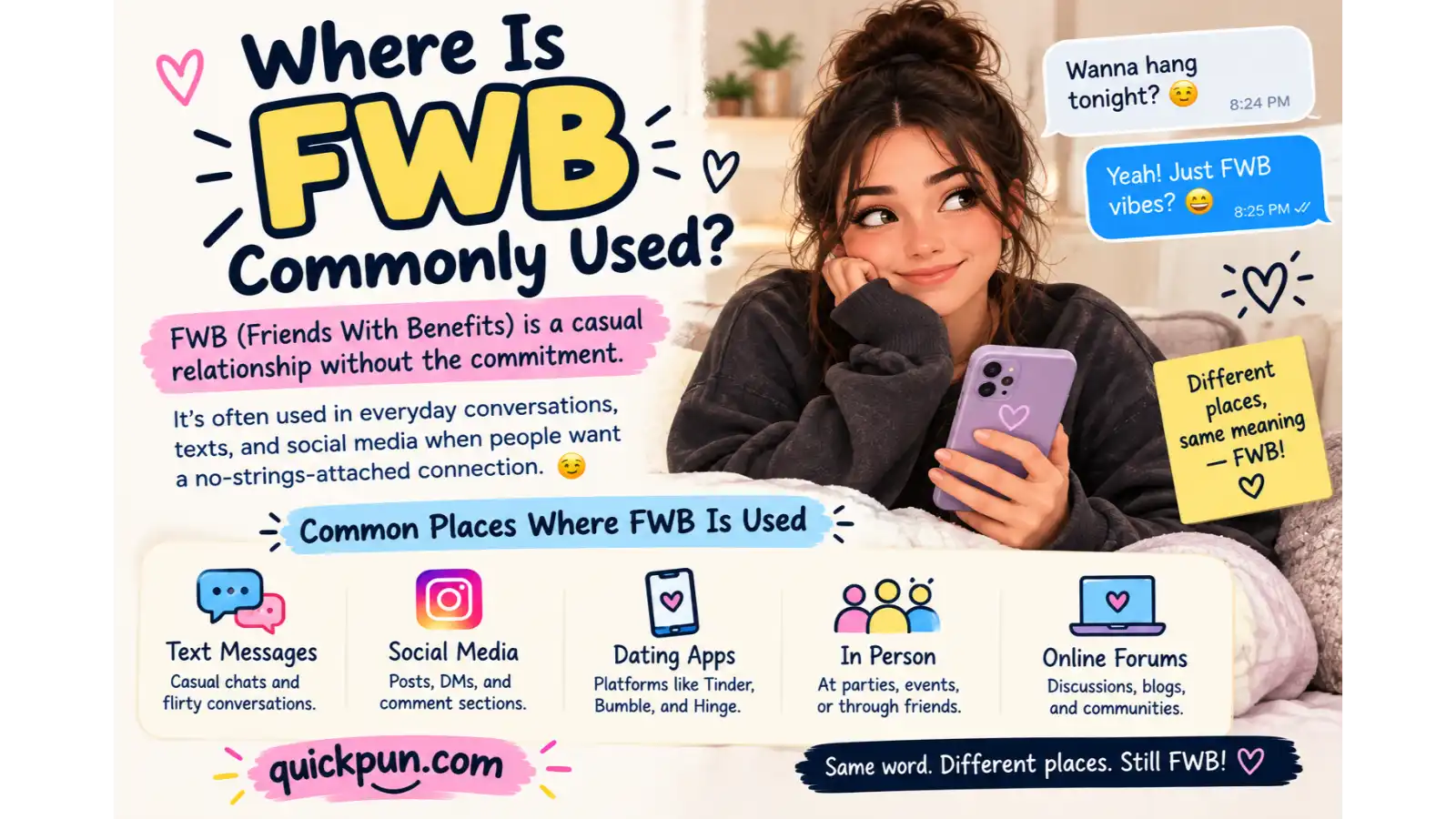
Where Is FWB Commonly Used?
The abbreviation FWB appears across many digital platforms. It is especially common in conversations about dating, relationships, and casual connections.
Text Messages
FWB is often used in private text messages because abbreviations save time.
Someone might write:
“Would you consider FWB?”
or:
“I don’t want a relationship right now, just FWB.”
Because texting is informal, people often prefer short expressions instead of writing the full phrase.
On WhatsApp, FWB may appear in one-on-one conversations or group discussions about dating and relationships.
For example:
“Do you think FWB can actually work?”
The person is discussing whether a friends-with-benefits arrangement can work successfully.
Snapchat
Snapchat conversations are usually casual and quick, so abbreviations are common.
A person may use FWB in a private snap or chat when discussing relationships.
For example:
“Are you two dating or FWB?”
The meaning depends on the conversation, but the abbreviation normally refers to “friends with benefits.”
FWB can also appear in Instagram DMs, comments, or relationship-related conversations.
For example:
“I’m not looking for anything serious, maybe FWB.”
The person is communicating their preference for a casual arrangement.
TikTok
On TikTok, FWB may appear in comments, captions, videos, or discussions about modern dating.
Someone might comment:
“FWB sounds complicated.”
Here, the person is referring to the friends-with-benefits concept.
Gaming and Discord
Although FWB is more strongly connected with dating and social conversations, it can occasionally appear in gaming communities or Discord chats when users discuss their personal lives.
However, if you see FWB in a gaming context, don’t immediately assume it has the relationship meaning. Always check the surrounding conversation.
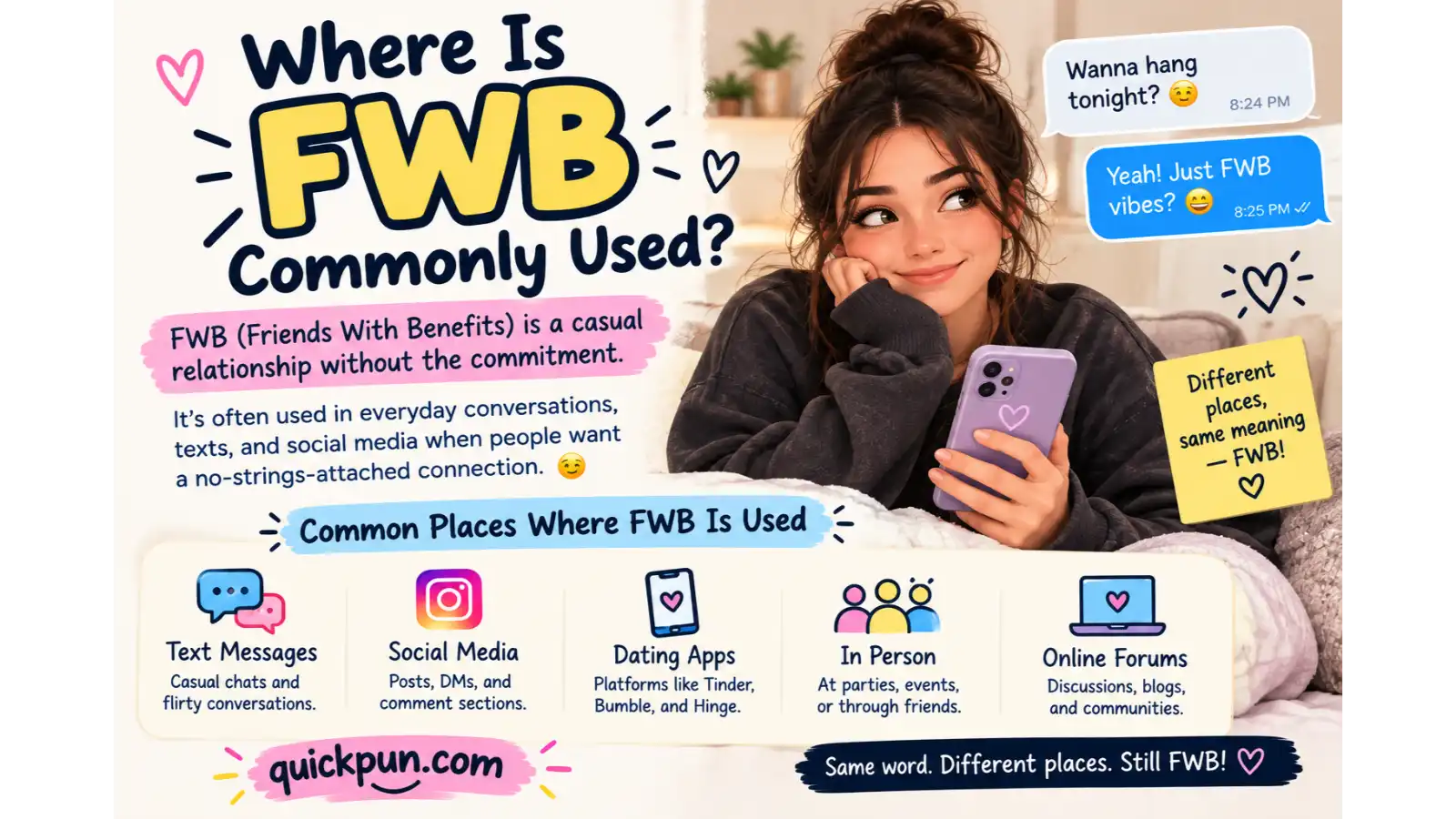
Tone and Meaning Explained
The FWB slang meaning is usually straightforward, but the tone can change depending on how someone uses it.
Friendly Tone
FWB can be used in a calm and straightforward way.
For example:
“I think we’re better as FWB.”
This does not necessarily sound rude. The person is simply describing the type of relationship they want.
Another example:
“Would you be interested in an FWB arrangement?”
This sounds like a direct question rather than an insult.
Neutral Tone
FWB is often neutral when people are simply discussing relationships.
For example:
“What does FWB mean?”
or:
“Have you ever had an FWB situation?”
The abbreviation itself is not automatically positive or negative. The surrounding words determine the emotional tone.
Rude or Cold Tone
FWB can feel cold if someone uses it without considering the other person’s feelings.
For example:
“I don’t want anything from you except FWB.”
Depending on the situation, this may sound blunt or emotionally distant.
Likewise, if someone assumes you want an FWB relationship without asking about your preferences, the message may feel uncomfortable.
So, FWB is not inherently rude, but the way someone introduces or discusses it can make the conversation feel respectful, casual, awkward, or insensitive.
Examples of FWB in Conversation
Here are several realistic chat-style examples showing how people might use FWB.
Example 1: Asking About Intentions
Alex: “Are you looking for a relationship?”
Sam: “Not right now. Maybe FWB.”
Here, Sam is saying they are not currently looking for a serious relationship.
Example 2: Clarifying a Relationship
Mia: “So, are you guys together?”
Emma: “No, we’re FWB.”
Emma is explaining that they are not officially dating.
Example 3: Setting Expectations
Ryan: “What are you looking for?”
Lily: “Honestly, something casual. Maybe FWB.”
The person is making their intentions clear.
Example 4: Asking for Meaning
Tom: “She said FWB. What does that mean?”
Chris: “It means friends with benefits.”
Here, FWB is simply being explained as an abbreviation.
Example 5: Discussing Dating
Ava: “I don’t think I want a serious relationship right now.”
Noah: “Would FWB be something you’d consider?”
The conversation is about different relationship possibilities.
Example 6: Talking About a Friend
Sara: “Are you dating Mark?”
Kate: “Not exactly. We’re FWB.”
The speaker is making a distinction between dating and an FWB arrangement.
Example 7: Setting a Boundary
Jordan: “Would you be interested in FWB?”
Taylor: “Thanks for asking, but that’s not what I’m looking for.”
This shows that someone can clearly communicate their preference without misunderstanding the abbreviation.
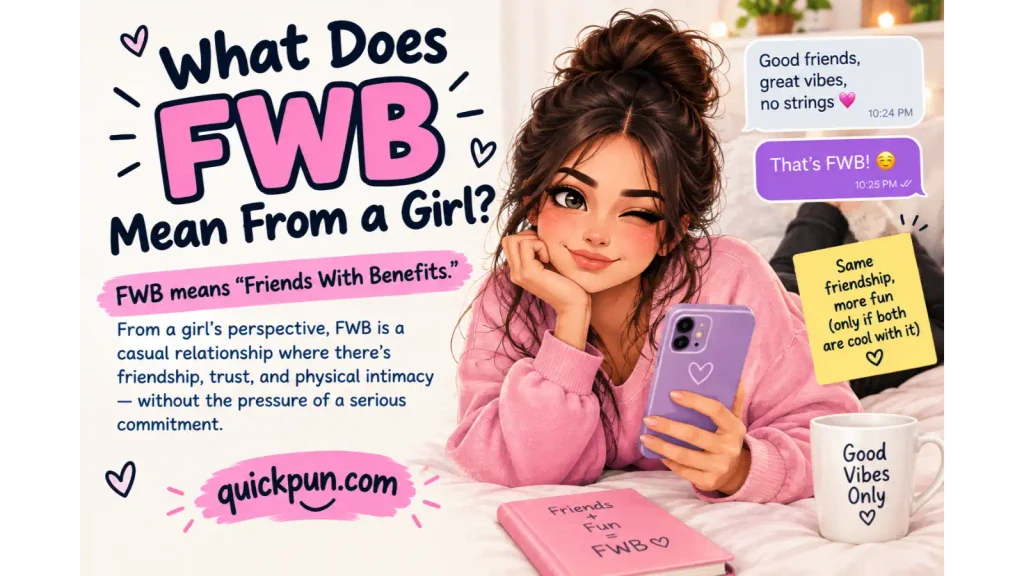
FWB Meaning From a Girl
If a girl sends you FWB, the basic meaning is still “friends with benefits.” However, the emotional meaning can depend on her exact message and your relationship.
For example, if she says:
“I’m not ready for a relationship. Maybe FWB?”
She may be communicating that she wants something casual rather than a traditional committed relationship.
If she says:
“Would you ever consider FWB?”
She may simply be asking about your opinion or interest.
If she says:
“We’re basically FWB.”
She may be describing an existing relationship.
It is important not to assume that FWB means she has romantic feelings, wants a serious relationship later, or expects the arrangement to develop into something else.
The safest approach is to understand the words she actually uses and, if necessary, ask politely what she means.
For example:
“When you say FWB, what kind of arrangement do you mean?”
That keeps the conversation clear instead of relying on assumptions.
FWB Meaning From a Guy
When a guy uses FWB, it generally has the same basic meaning: friends with benefits.
For example:
“I’m not looking for anything serious. I’d be okay with FWB.”
This usually means he prefers a casual arrangement instead of a committed romantic relationship.
A guy might also say:
“Would you be interested in FWB?”
In this case, he is asking whether you would consider that type of relationship.
There is no universal difference between the abbreviation when used by a guy or a girl. The important part is the context and the person’s intentions.
It is better to focus on the actual conversation rather than assuming that FWB has a special meaning based only on who sent it.
Is FWB Ever Rude or Offensive?
The abbreviation FWB is not automatically rude or offensive. It is a commonly used slang term for a type of relationship.
However, the way it is used can make it feel uncomfortable.
When It Sounds Dry
A message such as:
“FWB?”
can feel extremely short or dry because there is almost no context.
The sender may simply be typing quickly, but the receiver may wonder what they are actually asking.
When It Sounds Passive-Aggressive
If someone uses FWB after an argument or emotional conversation, it could feel dismissive.
For example:
“So I guess you only want FWB.”
The issue here is not the abbreviation itself. The tone comes from the surrounding situation.
When It Sounds Polite
A more respectful version could be:
“I enjoy spending time with you. Would you ever be comfortable with an FWB arrangement?”
This gives the other person room to express their feelings and boundaries.
The key difference is how the term is introduced and communicated.
When to Use and When NOT to Use
Knowing when to use FWB can help you avoid awkward conversations.
| When to Use ✅ | When NOT to Use ❌ |
|---|---|
| When discussing casual relationships | In a formal work email |
| When both people understand the term | With someone who may not know slang |
| In informal texting | In professional communication |
| When discussing dating preferences | When making assumptions about someone |
| In casual social media conversations | As an insult |
| When the relationship topic is already clear | When the situation requires a more sensitive explanation |
FWB is primarily an informal abbreviation. It works best in personal conversations where the topic already relates to dating or relationships.
If you are unsure whether the other person understands it, simply write the full phrase or explain what you mean.
FWB Meaning in Chat vs Social Media
The FWB meaning in chat is usually direct because private conversations provide more context.
For example:
“I’m not ready to date seriously. Would FWB work for you?”
The meaning is quite clear.
On social media, however, FWB can appear in a much broader range of situations.
A TikTok caption might say:
“Things I learned from my FWB era.”
An Instagram comment might say:
“Is this about your FWB?”
On social media, people sometimes use slang for humor, storytelling, trends, or personal experiences. Therefore, you should look at the entire post or conversation before deciding exactly what the person means.
The basic definition remains the same, but the context changes the tone and purpose.
Similar Slang Words or Alternatives
Several terms are related to FWB, although they do not all mean exactly the same thing.
| Word | Meaning | Usage |
|---|---|---|
| FWB | Friends with benefits | Casual relationship involving friendship and intimacy |
| Situationship | A relationship without a clear official label | Used when romantic status is unclear |
| Casual dating | Dating without a strong commitment | Common in modern dating conversations |
| Hookup | A casual intimate encounter | Informal relationship slang |
| Dating | Spending time with someone romantically | Can range from casual to serious |
| Partner | Someone in a romantic relationship | Usually suggests a more established relationship |
| Talking stage | Early stage of getting to know someone romantically | Common on social media |
| Ex | Former romantic partner | Used after a relationship ends |
These terms can overlap, but they should not be treated as exact synonyms.
For example, a situationship may involve romantic feelings and uncertainty, while FWB specifically points toward a friendship combined with an intimate relationship.
Other Meanings of FWB
In most texting, dating, and social media conversations, FWB means “friends with benefits.”
However, abbreviations can sometimes have other meanings in specific industries, organizations, communities, or technical contexts.
If you see FWB in a message that has nothing to do with relationships, do not automatically assume it means “friends with benefits.”
For example, a workplace document, technical discussion, business message, or specialized community could use the same letters for something completely different.
Context is therefore extremely important.
If the surrounding conversation includes words such as:
- Dating
- Relationship
- Friends
- Casual
- Serious
- Couple
- Romantic
- Benefits
then friends with benefits is very likely the intended meaning.
Why Do People Use FWB?
There are several reasons people use abbreviations such as FWB online.
Fast Typing
Typing “FWB” is much quicker than writing “friends with benefits.”
Texting culture rewards short and convenient expressions, especially when people are chatting quickly.
Internet Culture
FWB has become familiar through social media, dating conversations, online forums, and modern relationship discussions.
As people encounter the term repeatedly, it becomes easier to use without explaining it.
Convenience
A three-letter abbreviation can communicate a longer idea quickly.
Instead of writing:
“I want to have a friendship with someone but also have an intimate relationship without being in a traditional committed relationship,”
someone can simply say:
“I’m looking for FWB.”
Privacy
Some people may also prefer an abbreviation because it feels less direct than writing the complete phrase.
For example:
“Are you looking for FWB?”
can feel shorter and less formal than spelling everything out.
Still, using an abbreviation does not remove the need for clear communication. If the topic is important, explaining expectations is often better than relying on three letters.
How Should You Respond When Someone Says FWB?
Your response depends on what you want and how comfortable you are with the conversation.
If you do not understand the term, you can simply ask:
“What do you mean by FWB?”
If you understand it but are not interested, you can say:
“I understand what you mean, but I’m looking for something different.”
If you want more clarity, you can ask:
“What does FWB mean to you?”
That question can be useful because people may have different ideas about what the arrangement involves.
If you are interested in continuing the conversation, clear communication about expectations and boundaries is important.
The biggest mistake is assuming that both people automatically mean the same thing when they use the abbreviation.
FWB vs Dating: What Is the Difference?
FWB and dating are not necessarily the same thing.
Dating can involve romantic interest, emotional connection, commitment, or the possibility of becoming a couple.
FWB, on the other hand, usually describes a casual relationship between people who maintain a friendship while also having an intimate connection without treating the relationship as a traditional committed romance.
For example:
Dating:
“I really like you and want to see where this relationship goes.”
FWB:
“I like spending time with you, but I’m not looking for a traditional relationship.”
These are simplified examples, because every relationship is different.
The most important difference is usually the level and type of commitment people expect.
FWB vs Situationship
FWB and situationship are also different terms.
A situationship usually describes a relationship where the romantic status is unclear. Two people may act like a couple but have not clearly defined the relationship.
An FWB arrangement is generally more specific because the term identifies a friendship combined with an intimate relationship.
For example:
Situationship:
“We spend every weekend together, but we haven’t talked about what we are.”
FWB:
“We’re friends, but we’ve agreed to keep things casual.”
Again, real-life relationships can overlap, so the exact meaning depends on the people involved.
Can FWB Become a Serious Relationship?
Yes, an FWB arrangement can sometimes develop into a romantic relationship, but that is not what the abbreviation automatically promises.
Some people may eventually develop stronger feelings. Others may remain comfortable with a casual arrangement.
That is why it is risky to assume:
“FWB means we’ll eventually become a couple.”
It might happen, but it is not guaranteed.
If one person wants a serious relationship while the other wants to keep things casual, the difference in expectations can create emotional confusion.
Clear communication can help people understand whether they want the same thing.
Does FWB Mean There Are No Feelings?
Not necessarily.
The term usually suggests that the relationship is not a traditional committed romance, but people can still have emotions.
Someone may develop romantic feelings over time, while another person may not.
This is one reason the meaning of FWB should not be treated as a complete description of someone’s emotional state.
If you are trying to understand what a specific person means by FWB, look at their full message and communication rather than the abbreviation alone.
FAQs:
What does FWB stand for in texting?
FWB usually stands for “friends with benefits.” It describes a friendship that also includes an intimate relationship without necessarily being a traditional romantic partnership.
What does FWB mean from a girl?
If a girl says FWB, she usually means friends with benefits. Her exact intention depends on the conversation, so it is better not to assume more than what she actually says.
What does FWB mean from a guy?
When a guy uses FWB, it generally means friends with benefits as well. It often indicates interest in a casual arrangement rather than a traditional serious relationship.
Is FWB the same as dating?
No. FWB and dating can overlap, but they usually describe different relationship arrangements. FWB generally emphasizes friendship and casual intimacy, while dating can involve romantic interest and greater commitment.
Is FWB a bad word?
No. FWB is an informal slang abbreviation and is not automatically a bad or offensive word. However, it can be inappropriate in formal settings or uncomfortable depending on how someone uses it.
What does FWB mean in chat?
The FWB meaning in chat is usually “friends with benefits.” The term is commonly used when people discuss casual relationships or dating preferences.
Final Thoughts:
Understanding FWB meaning in text is easier once you know the basic definition: FWB usually means “friends with benefits.”
It is an informal term used in texting, WhatsApp, Snapchat, Instagram, TikTok, dating conversations, and other online spaces. The abbreviation normally describes a friendship that also includes an intimate relationship without necessarily being a traditional committed romance.
Still, three letters cannot explain an entire relationship.
If someone sends you “FWB,” pay attention to the words around it, the tone of the conversation, and what the person actually wants. When something feels unclear, asking a simple question is often better than guessing.
So, the next time you see FWB in a text, you will know what it usually means—and, more importantly, you will know that context matters just as much as the abbreviation itself. 💬

Peter Hemsworth is the mind behind QuickPun.com, where everyday words, slang, and internet expressions reveal their hidden stories. With a passion for uncovering what people really mean, he turns simple terms into fascinating reads that keep curious minds coming back for more. Dive in—you might discover there’s far more behind a word than you ever imagined.