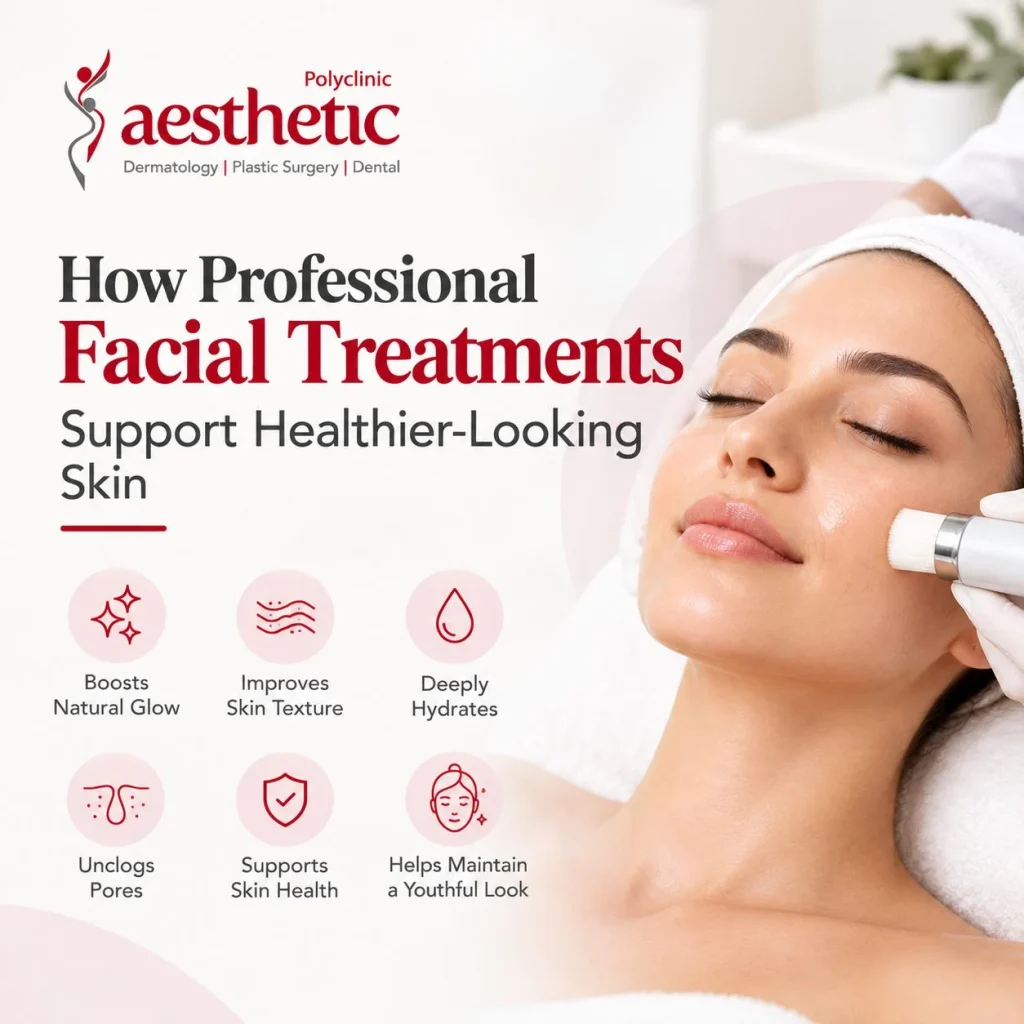
Someone can cleanse every night, layer serums correctly, and still see texture that will not smooth, a tone that stays uneven, or a dullness no hydration fixes. Such a situation is common, not a failure of effort.
Skincare can help with a lot, but what it does depends on the concern and how deep it sits. Early laxity, stubborn pigmentation, and persistent roughness, these often sit deeper than daily care reaches. A professional facial treatment fills that gap: assessment, a chosen mechanism, controlled intensity, and a plan built around the skin in front of the practitioner.
Key Takeaways
- A professional treatment works through assessment, not simply stronger products.
- Healthy-looking skin spans four dimensions: surface, optical, barrier and hydration, and structural quality.
- Different mechanisms, chemical, mechanical, light-based, or thermal, suit different concerns.
- Skin type, phototype, and treatment intensity affect safety and outcome.
- Home skincare and professional treatment support each other rather than compete.
What is Different About a Professional Facial Treatment?
The difference between a home routine and professional treatment is judgment, not raw strength. A qualified practitioner assesses texture, tone, hydration and firmness first.
A recent international consensus on skin quality argues that good results depend on identifying which aspects most limit its appearance, then treating those parameters. Skin quality is described using four categories: tone evenness, surface evenness, firmness, and glow.
What a Practitioner Actually Decides
Every advanced facial treatment involves choices that separate a controlled procedure from a stronger product:
- Which mechanism suits the concern
- How intense or deep treatment should be
- How many sessions the plan requires
- How recovery should be sequenced
Healthy-Looking Skin Is More Than Hydration
"Healthy-looking skin" is often reduced to one idea, usually hydration or glow. In clinical terms, skin quality is multidimensional, changing what a facial skin treatment should target.
The Four Dimensions of Skin Quality
- Surface quality: roughness, pores, fine lines and uneven texture
- Optical quality: dullness, pigmentation, redness, and tonal unevenness
- Barrier and hydration: dehydration, sensitivity, and compromised barrier function
- Structural quality: elasticity, laxity, crepiness, and deeper wrinkles
A person may have excellent hydration and still show poor surface quality, or strong structure with persistent pigmentation. A single skin rejuvenation facial rarely fixes every concern; planning should start with the limiting dimension.
How Different Facial Treatments Work
Each category works through a distinct mechanism, so the right choice depends on the concern, not which option is strongest.
Chemical Exfoliation
Peel depth and formulation determine how much of the epidermis, or occasionally deeper tissue, is affected.
Superficial peels mainly target texture and brightness, while medium-depth peels suit more marked photoaging and irregularity. Pigment-prone skin needs cautious selection because peel formulation, depth, skin type, and post-treatment inflammation can all influence pigment risk.
The American Academy of Dermatology notes that professionally administered peels treat uneven tone, rough texture, and fine lines and cautions against at-home peel products used without trained supervision.
Microneedling
Microneedling uses controlled mechanical micro-injury to stimulate dermal remodelling while largely preserving the epidermis. This injury-and-repair mechanism can address surface irregularity alongside early structural changes, with results developing progressively across a treatment course.
LED and Photobiomodulation
Light-based treatment works by biological modulation of cells, not by resurfacing or controlled injury. Evidence is mixed by wavelength and concern, so LED is generally a supportive, lower-intensity modality.
Energy-Based Treatments
Devices using thermal or other energy target specific tissue responses, but outcomes depend on device architecture, energy level, pulse duration, and depth. A recent review frames nonsurgical facial rejuvenation around three variables, Fitzpatrick skin type, barrier status, and photoaging severity, rather than device power alone.
Why Treatment Intensity and Skin Type Matter
No single setting works for every patient; intensity has to be calibrated to the skin at hand.
Factors That Shape Treatment Settings
Treatment settings should account for:
- Fitzpatrick phototype and pigmentation tendency
- Current skin condition, inflammation or sensitivity
- Degree of photoaging
- Treatment depth and desired endpoint
- Recovery tolerance
Considerations for Darker Skin Tones
For darker skin tones, many procedures can be performed safely with the right device selection and conservative settings, though pigmentation risk is never zero.
A systematic review and meta-analysis found laser resurfacing and chemical peeling comparably effective. Lasers may suit melasma better with fewer sessions but more short-term redness, while peels suit those wanting minimal downtime. Treatment choice should be individualised, not assumed from the modality alone.
Why Professional Treatment and Home Skincare Work Together
A facial skin treatment does not make home skincare unnecessary. Daily care plays a role in the baseline condition of the skin between procedures and in how well the skin tolerates and recovers from treatment.
Periprocedural Skincare Matters
A recent review of periprocedural skincare found gentle cleansers, moisturisers, antioxidants, and sunscreens may enhance recovery, particularly when adapted to barrier disruption. The right routine after a peel differs from one after microneedling or an energy-based session.
When multiple modalities are considered, sequencing also matters. Combining procedures without accounting for cumulative barrier disruption or inflammation can increase irritation without necessarily adding meaningful benefit.
A Note on Home Devices
Evidence for home-use devices varies by device, and at-home microneedling carries avoidable risks when depth or hygiene are not properly controlled.
When Is a Professional Facial Treatment Appropriate?
A skin rejuvenation facial is worth considering when:
- A specific concern, dullness, uneven texture, early laxity, or pigmentation has not responded to a consistent home routine
- Someone wants a more defined, monitored approach to a particular skin-quality goal
Individual assessment matters before deciding which mechanism is appropriate.
Choosing Advanced Facial Treatments in Dubai
Dubai's clinics offer many advanced facial treatments, from chemical peels to energy-based devices, making a starting point hard to pick. Prioritizing assessment over the treatment name helps; a practitioner examining the skin's four quality dimensions first is a better indicator of fit than marketing language.
At AestheticsCC, treatment planning typically begins with an individual assessment, matching the mechanism and intensity to the concerns identified during the consultation, rather than defaulting to one procedure for every patient.
FAQs
How often should professional facial treatment be done?
This depends on the mechanism and concern; superficial treatments may be spaced weeks apart, and intensive procedures need longer.
Are professional facial treatments suitable for sensitive skin?
Some can be, when parameters are adjusted for lower intensity and gentler mechanisms, with closer monitoring.
Can professional treatments replace daily skincare?
No. A professional treatment goes after specific problems in a controlled way. Daily care just keeps the skin steady in between.

I’m a Full Stack Web Developer with a Master’s degree in Software Engineering and building compelling, successful websites is my calling. I’ve been in this field for about 10 years and throughout that time I’ve designed plenty of web solutions for numerous businesses grow, attract new audiences and increase their revenue. I aim at delivering an outstanding experience and building long-term, mutually beneficial relationships with my clients.