
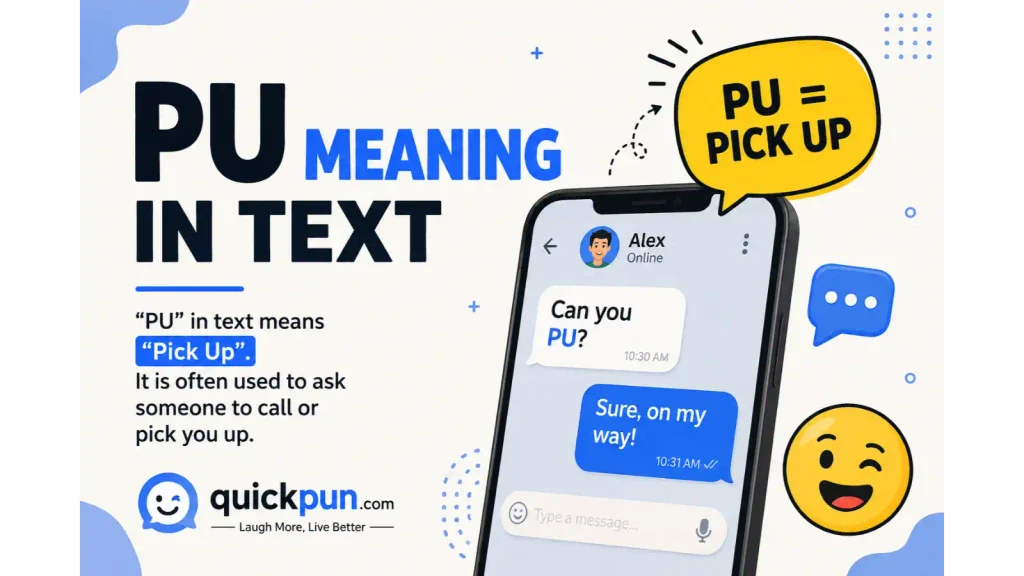
Imagine you are texting a friend and they suddenly reply, “PU?” You look at the message and wonder, “What does that even mean?” 😅
Short texting abbreviations can be confusing because the same two letters may have different meanings depending on the conversation. PU is one of those abbreviations.
Its meaning can change based on the person, platform, and context.
If you have seen PU in a text message, Snapchat, WhatsApp, Instagram, TikTok, or a gaming chat, this guide will help you understand what it means and how to respond.
Quick Answer: What Does PU Mean in Text?
PU meaning in text most commonly refers to “pick up” or “pop up,” depending on the context. In some conversations, PU can also be used as an expression related to an unpleasant smell, similar to “pew.”
The exact meaning depends on the sentence and conversation.
People may use PU to:
- Ask someone to pick something or someone up
- Tell someone to pick up the phone
- Refer to something that has popped up
- React jokingly to a bad smell
- Save time while typing
- Use casual internet slang
Tip: Always look at the words around “PU” before deciding what the sender means.
What Does PU Mean in Text?
So, what does PU mean in text?
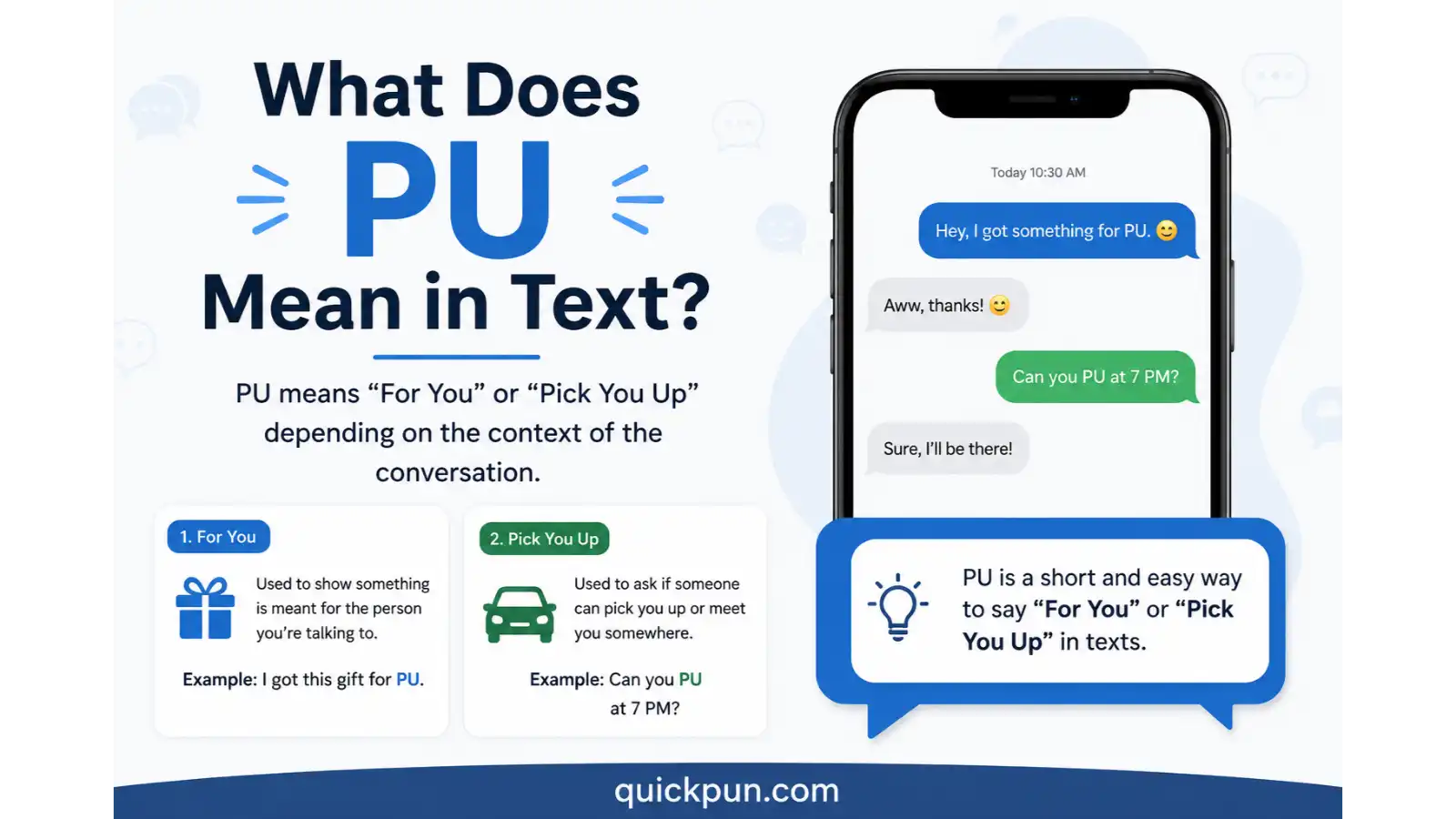
There is no single universal definition. In casual messaging, PU is often used as a shortened form of “pick up.”
For example:
Friend: “Can you PU me at 7?”
Meaning: “Can you pick me up at 7?”
Another example:
“PU the phone!”
This can mean “Pick up the phone!”
However, context matters. Someone might also type “PU” as a playful reaction to something that smells bad, similar to saying “pew!”
A few simple examples
Example 1:
“Can you PU the package?”
→ Can you pick up the package?
Example 2:
“PU at 8?”
→ Pick up at 8?
Example 3:
“PU 🤢 what is that smell?”
→ A playful reaction to a bad smell.
Because abbreviations are flexible, the conversation itself usually gives you the answer.
Where Is PU Commonly Used?
You may encounter PU in several online spaces. However, its meaning can change from one platform to another.

1. Text Messages 📱
Texting is probably where you are most likely to see PU used casually.
A friend might write:
“Can you PU me after school?”
Here, PU clearly means pick up.
People often shorten phrases when they are in a hurry or already have an established texting style with someone.
2. WhatsApp 💬
WhatsApp conversations can contain plenty of short forms.
Someone could message:
“PU the food on your way.”
Depending on the conversation, this may mean pick up the food.
WhatsApp users commonly shorten phrases because typing a few letters is quicker than writing the complete expression.
3. Snapchat 👻
Snapchat conversations are often short and informal.
You might see:
“PU?”
“Yeah, give me 10.”
Here, the meaning could depend on what the two people were discussing before that message.
If they were talking about transportation, PU could mean pick up.
4. Instagram 📸
On Instagram DMs, abbreviations can appear in quick conversations.
For example:
“Can you PU my order?”
The sender may simply be shortening pick up.
Instagram slang is usually highly dependent on context, so don’t assume every two-letter abbreviation has one fixed definition.
5. TikTok 🎵
TikTok comments and messages use many abbreviations and slang expressions.
PU could appear in a comment, caption, or private message. If it is connected to a smell or something unpleasant, it may be a playful “pew” reaction.
6. Gaming / Discord 🎮
Gaming chats are fast-paced, so short abbreviations are common.
For example:
“PU at spawn.”
If the players have already discussed transportation or collecting something, PU may mean pick up.
In gaming communities, however, slang can be community-specific. The surrounding conversation is important.
Tone and Meaning Explained
The meaning of PU is not only about the letters. The tone of the message can also tell you what the sender intends.
Friendly Tone 😊
When used between friends, PU can simply be a convenient shortcut.
For example:
“Can you PU me after work?”
There is nothing rude about it. The sender is just shortening pick up.
You may also see emojis:
“PU me at 6 😂”
The emoji makes the message feel relaxed and friendly.
Neutral Tone
In a neutral conversation, PU can be purely practical.
For example:
“PU package tomorrow.”
This is short and direct. It does not necessarily show anger or excitement.
The sender may simply want to communicate quickly.
Rude or Cold Tone 😐
PU itself is not normally a rude abbreviation.
However, any short message can feel cold when there is no additional context.
For example:
“PU.”
If you expected a longer answer, the extremely short reply might feel dry.
But that does not automatically mean the person is angry. They could simply be busy.
Examples of PU in Conversation
Here are some realistic examples showing how PU might appear in everyday chats.
Example 1: Getting a Ride
Alex: “Are you coming to the party?”
Sam: “Yeah.”
Alex: “Need me to PU you?”
Sam: “Yes please 😂”
Meaning: “Do you need me to pick you up?”
Example 2: Picking Up Food
Mia: “Can you PU pizza on your way home?”
Jake: “Sure, what kind?”
Here, PU means pick up.
Example 3: Picking Up a Package
Sara: “Your package is ready.”
Tom: “I’ll PU it tomorrow.”
Again, PU means pick up.
Example 4: Phone Conversation
Mom: “Why aren’t you answering?”
Son: “Sorry, I was driving.”
Mom: “PU when you stop.”
Here, the intended meaning is pick up the phone when you stop.
Example 5: Smell Reaction 🤢
Friend 1: “What’s that smell?”
Friend 2: “PU 🤢”
In this context, the person may be using PU as a playful spelling of “pew,” a reaction to something that smells bad.
Example 6: Quick Planning
A: “What time?”
B: “PU at 7?”
A: “Works for me.”
Here, the conversation suggests pick up at 7.
Example 7: Casual Reminder
A: “Don’t forget to PU the clothes.”
B: “Got it.”
Here, the abbreviation is being used as a quick version of pick up.
PU Meaning From a Girl
If a girl sends you PU, it usually does not have a special romantic meaning by itself.

The meaning depends heavily on the conversation.
For example:
“Can you PU me at 8?”
This most likely means:
“Can you pick me up at 8?”
It is practical rather than romantic.
However, tone can change depending on the relationship.
If she says:
“PU 😂”
The emoji may make the message more playful.
If she says:
“PU me after class?”
She may simply be asking for a ride.
If she says:
“PU 🤢”
She could be reacting to something that smells unpleasant.
So, if you are searching for PU meaning from a girl, don’t automatically assume it represents flirting or hidden feelings. Look at the full conversation.
PU Meaning From a Guy
The same basic idea applies when a guy uses PU.

If he says:
“Can you PU me?”
He is probably asking whether you can pick him up.
If he says:
“PU the package.”
He likely means pick up the package.
If he writes:
“PU 🤢”
The context may indicate the playful “pew” reaction to a bad smell.
There is generally no universal difference between PU meaning from a guy and PU meaning from a girl.
The person’s individual texting habits matter more than gender.
Is PU Ever Rude or Offensive?
Usually, PU is not an offensive abbreviation.
But the way someone uses it can affect how the message feels.
When PU Feels Dry
A message such as:
“PU.”
can feel very short.
If someone normally sends long messages and suddenly starts using one-word replies, you might interpret it as dry.
Still, you should not assume they are angry without more evidence.
When PU Feels Passive-Aggressive
Context can make almost any short message sound passive-aggressive.
For example:
“PU your stuff.”
If the person is already annoyed, the message may feel like a command.
The issue is the tone of the overall conversation, not the abbreviation itself.
When PU Is Polite
If someone says:
“Could you PU the package when you get a chance?”
The phrase is casual but still polite.
The surrounding words matter much more than the abbreviation.
When to Use and When NOT to Use PU
Not every situation is suitable for abbreviations.
| When to Use PU ✅ | When NOT to Use PU ❌ |
|---|---|
| Casual texting with friends | Formal business emails |
| Quick WhatsApp messages | Academic writing |
| Informal group chats | Professional documents |
| Gaming conversations | Important official messages |
| Conversations where the meaning is obvious | When the recipient may not understand |
| Casual planning | Formal customer communication |
A simple rule
Use PU when the other person already understands your texting style.
If there is any chance of confusion, write the complete phrase instead.
For example, instead of:
“Can you PU?”
you could write:
“Can you pick me up?”
That is much clearer.
PU Meaning in Chat vs Social Media
The PU meaning in chat can be different from what someone intends on social media.
In private chats
Private conversations usually provide more context.
If someone says:
“PU me at 9.”
You may already know you are discussing a ride.
Therefore, PU = pick up is easy to understand.
On social media
A social media post or comment may provide less context.
If someone comments:
“PU 😂”
you may need to look at the picture, video, caption, or previous comments.
It could be an abbreviation, a reaction, or a playful spelling of “pew.”
Why context matters
Short slang is often ambiguous when it appears alone.
The same letters can mean different things to different people.
That’s why you should always consider:
- The sentence
- The platform
- The conversation topic
- The sender’s usual texting style
- Emojis
- Previous messages
Similar Slang Words or Alternatives
If you are learning texting abbreviations, there are several expressions related to PU that may appear in casual conversations.
| Word | Meaning | Usage |
|---|---|---|
| PU | Pick up / context-dependent | Casual texting |
| P/U | Pick up | Informal messages |
| Pick up | Collect or get someone/something | Clear everyday English |
| Grab | Get or collect something | Casual conversation |
| Get | Obtain or collect | General texting |
| Pew | Reaction to a bad smell | Playful/casual |
| BRB | Be right back | Texting and gaming |
| OMW | On my way | Travel/planning chats |
| LMK | Let me know | Casual messages |
| WYD | What are you doing? | Texting and social media |
Remember that these expressions are not always interchangeable.
For example, OMW means someone is already traveling, while PU may describe the act of picking someone or something up.
Other Meanings of PU
The letters PU can have meanings outside casual texting.
Depending on the situation, PU might refer to different words, abbreviations, or expressions.
1. Pick Up
This is one of the most useful interpretations in casual messages.
Example:
“Can you PU the kids?”
Meaning:
“Can you pick up the kids?”
2. Pew / Bad Smell Reaction
Some people use PU as a playful spelling of “pew” when reacting to an unpleasant smell.
Example:
“PU! That smells terrible 🤢”
3. Context-Specific Abbreviation
In workplaces, schools, games, communities, or private groups, PU could have a specialized meaning.
This is why dictionary-style definitions do not always tell you what someone means in a particular message.
If the message makes no sense using pick up, consider the rest of the conversation.
Why Do People Use PU?
Why would someone type PU instead of simply writing pick up?
There are several reasons.
1. Fast Typing ⚡
Texting is designed for quick communication.
Writing:
“Can you pick me up?”
takes more time than:
“Can you PU me?”
When someone is busy, abbreviations can save a few seconds.
2. Internet Culture 🌐
Online communication has created thousands of abbreviations.
Expressions such as LOL, BRB, OMG, BTW, WYD, TBH, and LMK have become common because people enjoy communicating quickly.
PU can work in the same way when the context is clear.
3. Convenience
Sometimes people simply do not want to type the complete phrase.
Short forms are especially common between friends who already understand each other’s communication style.
4. Casual Communication
Abbreviations make conversations feel informal.
For example:
“Can you pick me up?”
sounds completely normal.
But:
“Can you PU me?”
feels more like casual texting.
5. Limited Space
Short messages can be useful in fast-moving group chats, gaming conversations, or social media comments.
However, convenience should not come at the cost of clarity.
FAQs:
What does PU mean in text?
PU most commonly means “pick up” in casual texting, especially when someone is talking about collecting a person, package, food, or another item. In some contexts, it can also be a playful version of “pew,” referring to a bad smell.
What does PU mean in chat?
The PU meaning in chat depends on the conversation. If the topic involves rides, packages, food, or collecting something, PU probably means pick up.
What does PU mean on Snapchat?
On Snapchat, PU can mean pick up when used in a conversation about getting someone or something. It may also have another meaning depending on the snap, caption, or conversation.
Is PU a bad word?
No. PU is not normally a bad word. It is usually a casual abbreviation or playful expression. However, the meaning can change depending on context.
Does PU mean pick up?
Yes, PU can mean “pick up.” For example, “Can you PU me?” can mean “Can you pick me up?” Context is important because PU can have other meanings.
What does PU mean from a girl or guy?
There is no special universal meaning based on gender. A girl or guy using PU could mean pick up, or another context-specific expression. Look at the complete conversation before interpreting it.
Final Thoughts:
Understanding PU meaning in text is mostly about looking at the context instead of focusing only on the two letters.
In many casual conversations, PU means “pick up,” especially when people are talking about rides, packages, food, or collecting something. In other situations, it can be a playful reaction similar to “pew” when something smells bad.
So the next time someone sends you “PU?”, don’t panic. 😄 Check the conversation around it, and the intended meaning will usually become clear.
When in doubt, you can always ask:
“What do you mean by PU?”
A quick question is better than guessing the wrong meaning.

Peter Hemsworth is the mind behind QuickPun.com, where everyday words, slang, and internet expressions reveal their hidden stories. With a passion for uncovering what people really mean, he turns simple terms into fascinating reads that keep curious minds coming back for more. Dive in—you might discover there’s far more behind a word than you ever imagined.